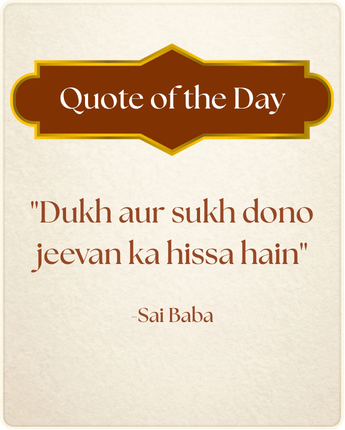

There have been many moments when I have sat in silence, without any intention to write, yet words began to emerge effortlessly. In those moments, I never felt like I was creating something—I felt like I was simply receiving. It was as if Sai Baba was guiding my thoughts, shaping my expressions, and allowing me to put into words what the heart feels but often cannot explain. These moments became the foundation of my writing journey.
I began by writing about my experiences—my visits to Shirdi, my moments of faith, my struggles, and the lessons I learned along the way. These were not meant for an audience; they were personal reflections, a way of understanding my own journey. But over time, I realized that these experiences were not just mine—they carried messages that could resonate with others as well.
Gradually, these writings evolved. What started as simple reflections turned into structured thoughts, then into poems, and eventually into books. Each piece of writing became a part of my spiritual journey, capturing a moment, a realization, or a feeling of deep connection with Sai Baba. Writing became a way for me to relive those moments and share them with others.
Among all forms of expression, bhajans hold a very special place in my heart. When words transform into music, devotion becomes more powerful and more accessible. A bhajan is not just sung—it is felt. It carries emotion, energy, and a sense of surrender that touches the heart directly. Many of the bhajans I have written were not planned compositions; they were born out of moments of deep connection, when I felt completely immersed in Sai Baba’s presence.
There were times when a single line would come to me, and that line would slowly grow into a complete bhajan. At other times, entire lyrics would flow in one go, as if they were waiting to be expressed. In those moments, I realized that I was not the creator—I was simply an instrument.
Music has a unique way of connecting people. Through bhajans, I have seen how devotion can bring individuals together, creating a shared experience of faith and emotion. When people sing together, there is a sense of unity that goes beyond words. It is in these moments that devotion becomes collective, and the presence of Sai Baba can truly be felt.
I have never approached writing with the intention of achieving recognition or creating something extraordinary. My only intention has always been to express what I feel and to share the peace, love, and faith that Sai Baba has blessed me with. For me, writing is not about perfection or complexity—it is about honesty and sincerity.
If even one person reads my words or listens to a bhajan and feels a sense of calm, hope, or connection, I believe my purpose is fulfilled. That is the only measure of my work—not how many people see it, but how deeply it touches someone’s heart.
Through writing, I have also learned to observe life more closely. It has made me more aware of my thoughts, my emotions, and my actions. It has helped me stay connected with my inner self, even in the midst of a busy and demanding life. Writing has become a form of meditation for me—a space where I can reflect, express, and reconnect.
Over time, I have come to understand that devotion is not limited to one form. It can be expressed through prayer, through service, through silence, or through creativity. For me, it has taken the form of words—words that carry faith, words that carry gratitude, and words that carry the essence of my journey.
Even today, whenever I sit down to write, I do so with a sense of surrender. I do not think too much about structure or outcome—I simply allow the words to flow naturally. And in that flow, I find a deep sense of peace and fulfillment.
Writing, for me, is not just an activity—it is a path. A path that keeps me connected to Sai Baba, grounded in faith, and aligned with my purpose.
And with every word I write, every verse I compose, and every bhajan I create, I offer my gratitude—knowing that it is all His grace, and I am only a medium through which it flows.